Building Anti-Abuse Systems for High-Risk Hosting Environments. A Technical Perspective with Web-CP
Modern hosting environments increasingly face a difficult balancing act: enabling innovation while maintaining strict compliance with legal and ethical standards. Platforms that support “risky” or high-scrutiny projects—such as user-generated content platforms, streaming services, or certain fintech applications—must implement robust anti-abuse systems to remain viable. Web-CP, a PHP-based hosting control panel, approaches this challenge by embedding automated abuse detection and mitigation workflows directly into the hosting layer.
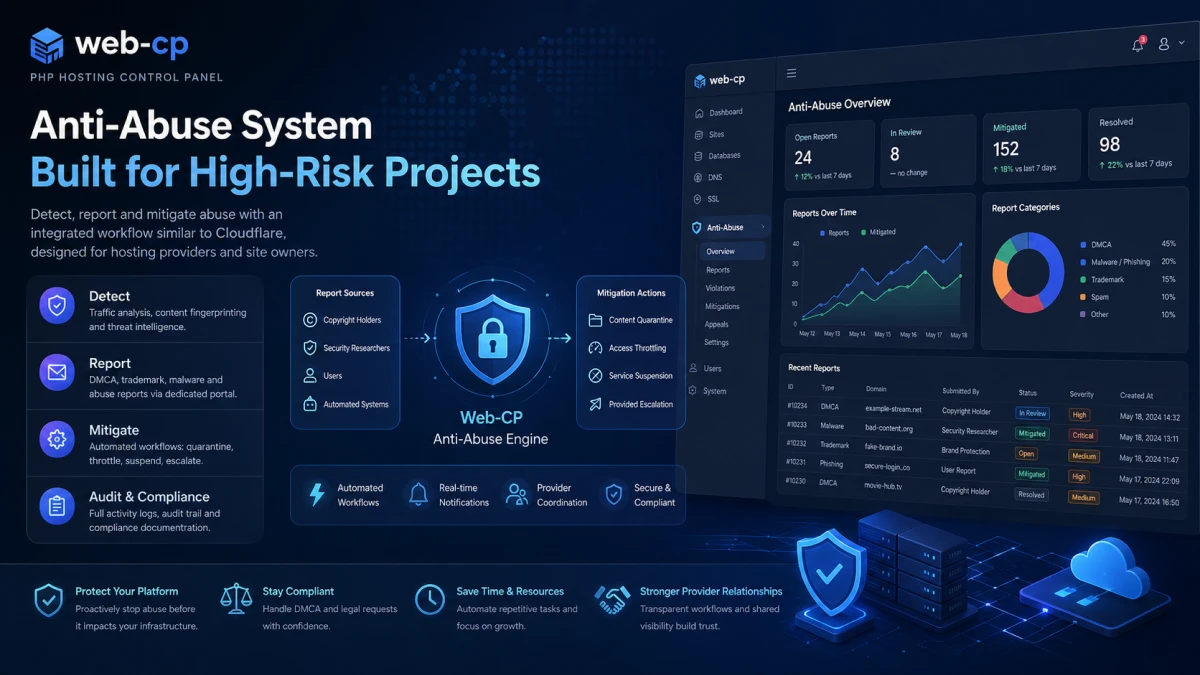
At its core, an anti-abuse system must solve three problems: detection, reporting, and resolution. Traditional hosting setups often treat these as external processes handled via support tickets or manual interventions. Web-CP instead integrates these layers into a unified pipeline, allowing hosting providers and site owners to respond to abuse reports in near real-time.
Detection and Signal Aggregation
Web-CP leverages multiple detection vectors to identify potentially abusive activity. These include:
Traffic anomaly detection (sudden spikes, bot-like behavior patterns)
Content fingerprinting (hash-based matching against known infringing materials)
Heuristic analysis (pattern recognition for phishing, malware distribution, or spam campaigns)
The system is designed to be extensible, allowing providers to plug in third-party intelligence feeds or custom rule engines. This modularity is critical for adapting to evolving abuse patterns.
Integrated Reporting Layer
One of the most significant innovations in Web-CP is its built-in abuse reporting interface. Similar in philosophy to large-scale edge networks, the platform enables external entities—copyright holders, security researchers, or users—to submit structured reports directly into the system.
Reports can include:
DMCA takedown notices
Trademark complaints
Malware or phishing alerts
General abuse reports
Each submission is automatically parsed, categorized, and assigned a severity score. Web-CP uses this metadata to trigger predefined workflows, such as notifying the site owner, rate-limiting access, or temporarily isolating the affected resource.
Automated Mitigation Workflows
Once a report is validated, Web-CP executes mitigation actions through policy-driven automation. These actions can include:
Content quarantine: Moving flagged files to a restricted environment
Access throttling: Limiting incoming traffic to affected endpoints
Service suspension hooks: Temporarily disabling accounts or domains
Provider escalation: Forwarding verified complaints to upstream hosting providers
The system maintains a full audit trail, ensuring that all actions are logged and reversible if necessary. This is particularly important for compliance and dispute resolution.
High-Risk Niches in Hosting
Certain industries are statistically more likely to generate abuse reports due to the nature of their operations. Examples include:
Online gambling and betting platforms
Adult content services
File sharing and streaming sites
Cryptocurrency-related services
User-generated content platforms (forums, social networks)
These niches often operate under heightened regulatory scrutiny and must demonstrate proactive abuse management to maintain infrastructure stability.
Before integrating Web-CP, handling abuse reports was a manual and reactive process for us. As an online gambling platform, we deal with frequent DMCA notices and compliance requests. Web-CP allowed us to automate report intake, categorize complaints, and coordinate directly with our hosting provider without delays. It significantly reduced operational overhead and improved our response times across the board.”
— Owner, LolaJack Casino
Provider-Level Coordination
A key strength of Web-CP is its ability to bridge the gap between site owners and hosting providers. Instead of fragmented communication via email or ticketing systems, the platform exposes a shared interface where both parties can:
View active abuse cases
Track mitigation status
Exchange compliance documentation
Enforce provider-specific policies
This reduces friction and ensures that both sides operate with the same data and timelines.
Security and Compliance Considerations
From a technical standpoint, the anti-abuse subsystem must be secure by design. Web-CP implements:
Role-based access control (RBAC) for abuse management features
Signed report submissions to prevent spoofing
Encrypted audit logs for tamper resistance
API rate limiting to prevent abuse of the reporting system itself
Additionally, the platform supports jurisdiction-aware policies, allowing providers to tailor responses based on regional legal requirements.
As hosting environments become more complex and regulated, anti-abuse systems are no longer optional—they are foundational. Web-CP demonstrates how integrating detection, reporting, and mitigation directly into the control panel can transform abuse handling from a reactive burden into a streamlined, automated process.
For operators in high-risk niches, this approach not only improves compliance but also enhances operational efficiency and trust with infrastructure providers. By treating abuse management as a first-class feature, Web-CP sets a new standard for modern hosting platforms.