How RNG Works in Online Casino Games
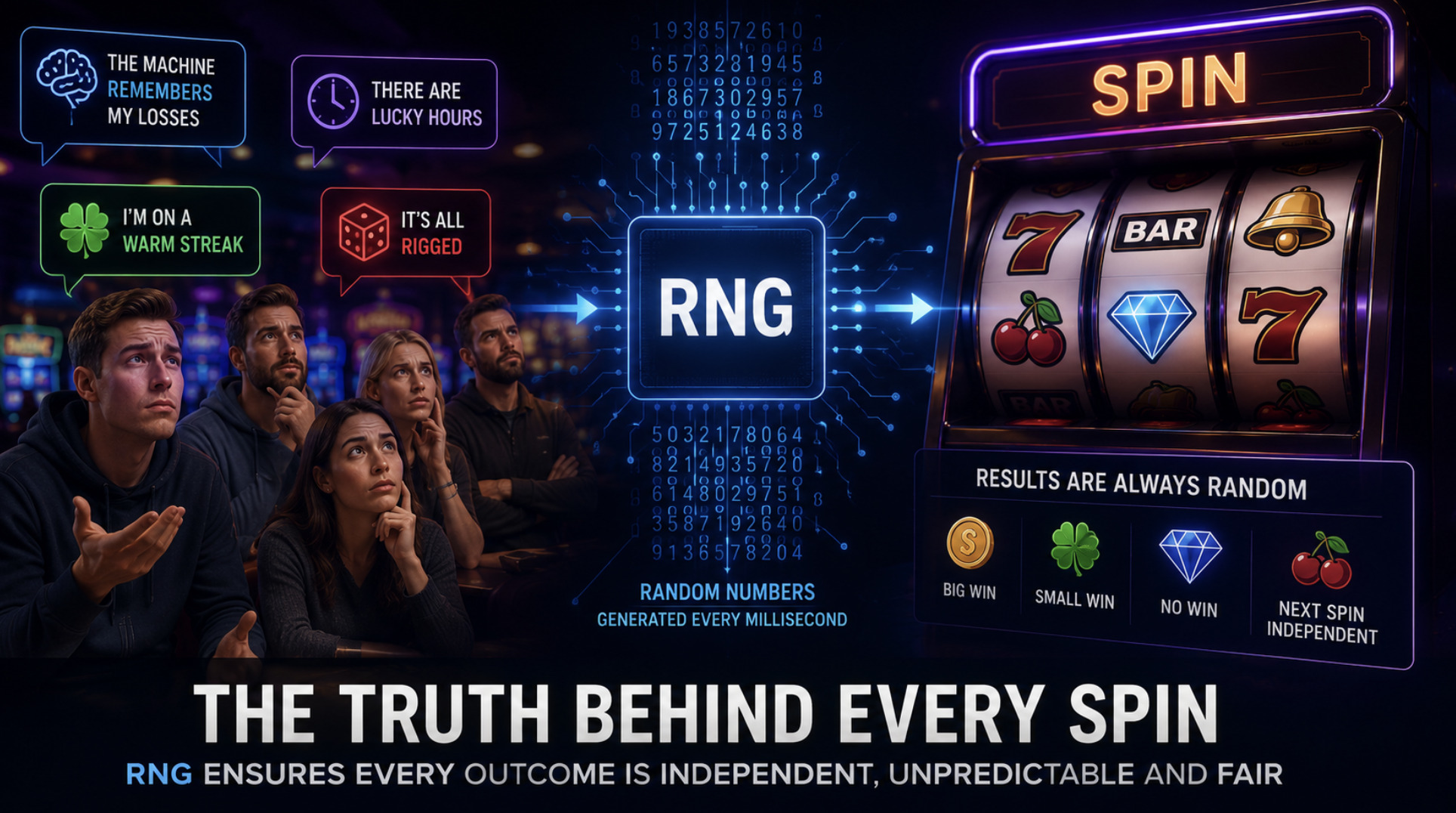
Ask a room full of online casino players whether the games are "really" random and you will get a surprising range of answers. Some are certain the machine remembers their losses and tightens up. Others believe there are lucky hours, warm streaks and cold ones. A few suspect the whole thing is rigged the moment they start winning. Almost all of these beliefs trace back to a single piece of technology that most players have never had explained to them: the random number generator, or RNG. It is the quiet engine behind every spin, shuffle and roll, and once you understand how it actually works, most of the folklore around online gambling simply evaporates.
This is not an abstract curiosity. Understanding the RNG is the difference between chasing patterns that do not exist and playing with a clear head, and it is also the foundation on which the entire concept of a fair digital game rests. So it is worth taking the time to understand what an RNG is, how it produces outcomes, why those outcomes can be trusted, and how independent testing turns a claim of fairness into something verifiable.
The core idea: unpredictable numbers on demand
At its heart, a random number generator is a system that produces numbers with no discernible pattern, one after another, continuously. Inside an online casino game, that stream of numbers never stops flowing while the game is loaded. The instant you press "spin," the game takes whatever number the generator is producing at that exact microsecond and maps it onto an outcome — a particular arrangement of symbols on the reels, a specific card from the deck, a number on the roulette wheel. Because the generator is producing values thousands of times a second and the precise instant of your click is effectively impossible to time, the result cannot be anticipated or nudged. You are, in effect, reaching into an endlessly churning stream and grabbing whatever happens to be passing.
The single most important property of this process is independence. Every outcome is drawn fresh, with no link whatsoever to the outcomes that came before it. The generator has no ledger of your session, no awareness that you have lost ten spins in a row, no sense that a jackpot is "overdue." Each spin begins from a clean draw, statistically identical to the last. This is the fact that quietly demolishes the largest category of gambling superstition. A slot cannot be "due" because it has no memory to be due from. It cannot run "hot" or "cold" in any predictive sense, because heat and cold would require a pattern, and a well-built generator produces none.
Pseudo-random versus true random
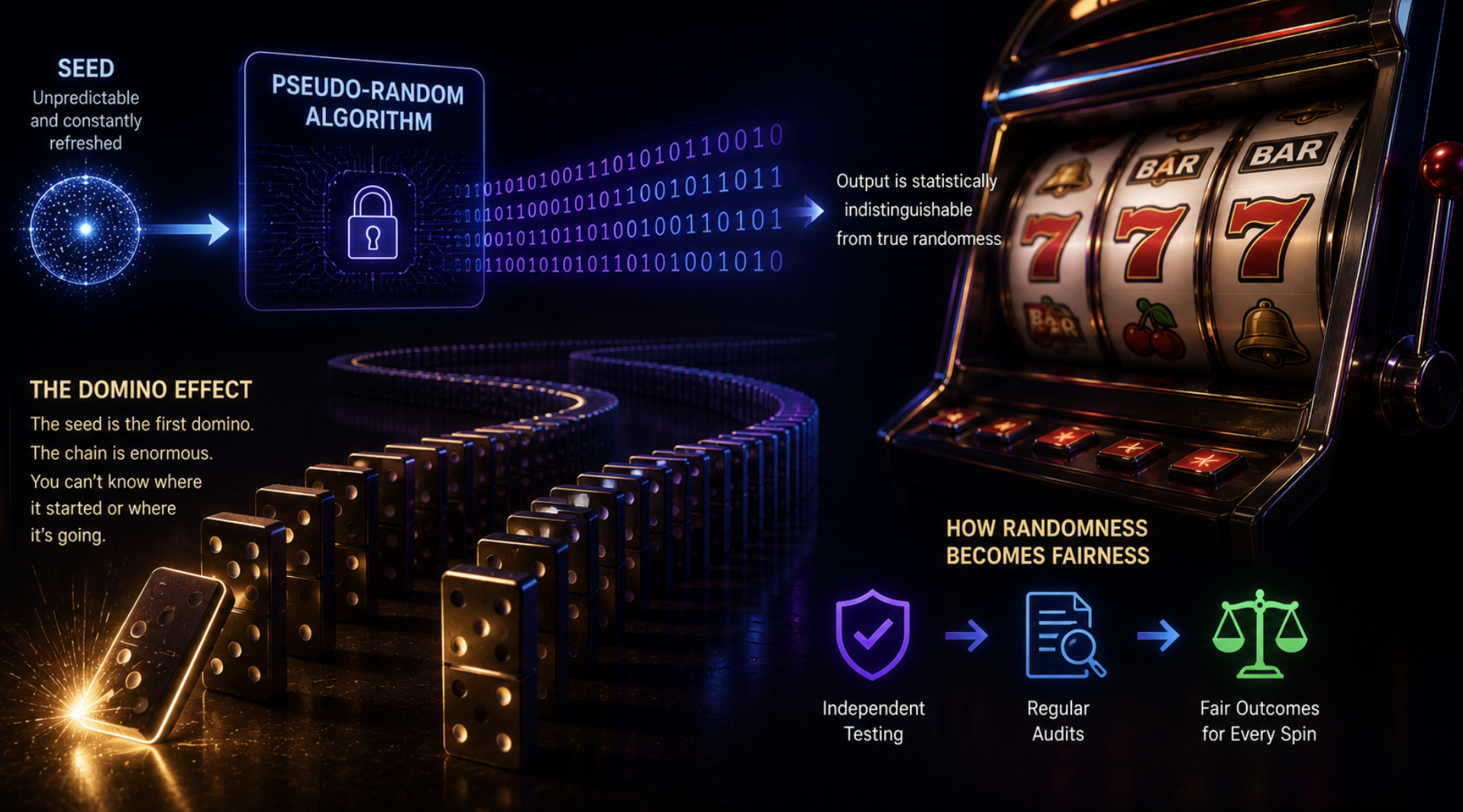
Not all randomness is generated the same way, and the distinction matters. The generators used in most online casino games are what engineers call pseudo-random number generators. They rely on a sophisticated mathematical algorithm that begins from a starting value, known as a seed, and produces a long sequence of numbers that behaves, for every practical purpose, exactly like true randomness. The word "pseudo" is where players sometimes get nervous, but it does not mean "fake" or "predictable." It simply means the numbers are computed by an algorithm rather than harvested from a physical source. A properly designed pseudo-random generator is so complex, and reseeds itself so frequently from unpredictable inputs, that no player could ever anticipate its next output, no matter how many previous results they studied.

The alternative is a true random number generator, which does not calculate its numbers at all. Instead it measures some genuinely unpredictable physical phenomenon — the tiny electrical noise in a circuit, for example — and converts that natural chaos into numbers. True generators are the tool of choice in the most security-critical fields, such as cryptography, where even a theoretical shortcut to prediction would be catastrophic. For casino gaming, a well-implemented and independently tested pseudo-random generator is more than sufficient, delivering randomness that is statistically indistinguishable from the real thing while being efficient enough to run smoothly in a browser or app.
To make the pseudo-random approach concrete, think of the seed as the first domino in an enormously long, intricate chain. Knock it over and the entire sequence unfolds deterministically — but the chain is so long and so tangled, and the starting domino is chosen so unpredictably and refreshed so often, that no observer standing partway along could ever work out where it began or where it will go next. That combination of a strong algorithm and constantly changing, unpredictable seeding is what makes the output secure against prediction.
How randomness becomes fairness
Here is where the technology connects to something players actually care about: fairness. The fairness of an online casino game rests entirely on the integrity of its random number generator. Because the generator produces outcomes that are both unpredictable and independent, neither the player nor the operator can know or influence a result before it happens. That symmetry is the whole point. A digital slot is the honest equivalent of a physical one precisely because every outcome is a fresh, uninfluenced draw, and the game's long-run return — its RTP — emerges naturally from the statistics of millions of those independent draws rather than from anyone tilting the odds mid-session.
This is also the reason the "the casino turned the game against me when I started winning" belief is mistaken at a regulated operator. The certified generator does not react to your balance, your win streak or the time of day. It is indifferent to you entirely, which is exactly what you want from something meant to be fair. Regulated platforms turn this from a promise into something checkable: operators such as Casoola and other licensed Canadian sites run games whose generators are examined by independent laboratories, so the randomness is confirmed by a neutral third party rather than simply asserted by whoever profits from the games.
Testing and certification — the part that builds trust
A claim of randomness is only as good as the evidence behind it, and this is where independent testing laboratories come in. Firms whose names recur across the industry — eCOGRA, GLI and iTech Labs among them — specialise in scrutinising casino RNGs. They subject a generator to vast batteries of statistical tests, examining millions upon millions of outcomes to confirm that the numbers behave the way genuine randomness should. In plain language, they are checking that no outcome shows up more often than probability says it should, that there are no repeating cycles a clever player could exploit, and that the distribution of results is as flat and unpredictable as true chance would produce.
A generator that passes this scrutiny is described as certified, and reputable, regulated operators use only certified generators. This external verification is the real backbone of trust in online gaming. It is also the clearest practical reason to prefer licensed operators over unregulated ones: at a regulated casino, the randomness has been tested by someone with no stake in the outcome, whereas an unregulated site's assurance of fairness is worth exactly as much as its willingness to be honest — which is to say, unknowable. In regulated Canadian markets, this testing sits alongside provincial oversight, adding a further layer of accountability to the games on offer.
The provably fair variant
Worth a brief mention is a newer idea that has emerged alongside cryptocurrency casinos, known as "provably fair." Rather than relying solely on an external lab's certification, it uses cryptographic techniques that let a player verify, after a round has finished, that the specific result was not tampered with. It typically works by combining a value contributed by the player with one from the operator to generate the outcome, so that neither side could have fixed it alone. Provably fair is a genuinely interesting development and a neat illustration of how the underlying principle — verifiable randomness — keeps evolving. It is not, however, a magic guarantee: it confirms a result was not altered, but it does not change the house edge or by itself prove a site is trustworthy in every other respect. For most players, an independently certified RNG at a regulated operator remains the practical gold standard.
The myths, dismantled
Because the RNG is invisible, it attracts more folklore than almost any other part of online gambling. A short reckoning is worthwhile:
"The game remembers my losses and adjusts." It has no memory. Each outcome is independent of every previous one.
"There are lucky and unlucky times to play." The generator runs identically at three in the morning and three in the afternoon. Time of day is irrelevant.
"After a long losing streak, a win is due." Probability resets every spin. A dry run does not make the next result any likelier to win.
"Patterns can be spotted and exploited." A tested generator produces no exploitable pattern. Systems that claim otherwise are selling something that does not exist.
Every one of these beliefs is a version of the same error: imagining that independent events are somehow connected. Once you see that each spin is a clean, memoryless draw, the myths lose their grip all at once.
Why any of this matters to you
Understanding the RNG changes how you play, and mostly by subtraction. You stop hunting for patterns, stop waiting for a machine to be "ready," and stop believing a losing streak owes you anything. You start seeing results for what they are — a run of independent random events that no strategy can steer. That clarity is quietly protective: it inoculates you against the systems, superstitions and "beat the slots" schemes that prey on players who do not understand the mathematics.
It also sharpens your judgement about where to play. A regulated operator running independently tested RNGs is offering fairness you can actually verify, which is precisely what the technology, correctly implemented, is designed to deliver. Anyone promising a method to outwit the generator is either confused about how it works or hoping you are. The honest truth is both simpler and more freeing: the games are random by design, that randomness is testable, and the smartest thing a player can do is understand it, respect it, and never mistake chance for a code waiting to be cracked.
How randomness plays out across different game types
It is worth noting that the RNG does not behave identically across every kind of casino game, even though the underlying principle is the same. In slots, the generator decides the entire outcome of each spin — every symbol position flows from the numbers drawn at the instant you press the button. In digital table games such as computer-based blackjack or roulette, the generator stands in for the physical apparatus, deciding which card is dealt or where the ball lands, again as an independent, memoryless draw. In these purely digital formats, the RNG is the sole source of the result.
Live dealer games are the interesting exception. Because a real human deals real cards or spins a real wheel, the core outcome comes from a physical process rather than a software generator, and fairness there rests on the integrity of that physical process under monitoring. Even so, elements around the live game may still use certified randomness, and the same expectation of independence applies — the previous hand has no bearing on the next. Understanding which games are decided by an RNG and which by a physical process helps a player know exactly where the fairness of a game comes from, and why the same "it's never due" logic holds across all of them.
Frequently asked questions
Are online casino games genuinely random? Yes, when they use a properly implemented, independently tested RNG. Certified generators produce outcomes that are statistically confirmed to be random and independent of one another.
Can anyone predict or beat an RNG? No. A well-designed, tested generator leaves no exploitable pattern, and every outcome is independent. Any system claiming to predict it does not work.
What does it mean that an RNG is "certified"? It means an independent laboratory has tested the generator across millions of outcomes and confirmed it behaves as true randomness should. Reputable regulated operators use only certified generators.
Is a slot ever "due" for a payout? No. Because each spin is independent, a slot is never due. A long losing run does not raise the odds of the next spin.
How is "provably fair" different from a certified RNG? A certified RNG is verified by an independent lab; provably fair is a cryptographic method, common at crypto casinos, that lets players confirm individual results were not altered. Both pursue verifiable fairness by different routes.